Since this blog will be throwing around the term “musical” all the time, often to refer to some fairly diverse works, I thought I’d take a moment to talk about the term.
What we call “musicals” today are descendents of the operas of the 17th – 19th centuries, which themselves grew out of oratorios, which harked back to the musical/poetic ritual dramas of ancient Greece and Rome. So while many theatre snobs sniff at musicals as inferior to “straight” drama, the notion of drama told only in words, with no music or songs, is a fairly new innovation. Even Shakespeare included songs and dances in many of his plays, and each show was likely provided incidental music by a lute player or small band.
In the world of opera (the word is Italian for “work” as in “a work of art”), there are two broad categories – the opera seria and opera comique. While it is broadly true that opera seria is more “serious,” tackling weighty subjects and noble themes, and opera comique is lighter and more populist in tone (not necessarily "comic" - the tragic Carmen of 1875 is an opera comique), the true distinction is a technical one. The main difference is that opera comique employs spoken dialogue to advance the plot, instead of the unbroken flow of music and singing found in opera seria. There are sub-categories and distinctions within these two broad classifications, of course, but for our purposes, this is enough.
As the operatic form became more and more popular with the masses, demand grew for lighter, more accessible works. Operettas, lighter in tone and in form based on the opera comique style of music and dialogue, fit the bill perfectly. It is the operetta, as perfected by Offenbach, Strauss, Gilbert & Sullivan and others, to which we owe the form of entertainment we know as “musical theatre.” In particular, the stunning success of HMS Pinafore (1878) granted respectability to the American theater – that notorious haunt of idlers and wantons, shunned by a nation descended from Puritans.
The transition from “operetta” to “musical” came about slowly, and involved much cross-pollenization with vaudeville (or music hall, as the Brits would have it). For a good long time, a “musical comedy” was a glorified revue with flimsy plots stringing the numbers together. Most people credit Hammerstein & Kern’s Show Boat (1927) as the first true musical – a work that integrated strong story and characters with songs that expressed emotion and moved the plot forward. It sounds like we are back to operetta, however, one might say that whereas an operetta is a light opera with dialogue, a musical is a play with songs. It’s a subtle distinction, but an important one, but there is plenty of room for overlap.
In recent years, musicals have moved back to their operetta and opera seria roots. The two major innovators in this area are Sondheim and Lloyd-Webber. Sweeney Todd (1979) is operatic in its scope, intensity, and the complexity of its score. Several of Lloyd-Webber’s productions, such as Evita (1978) and The Phantom of the Opera (1987), contain little to no spoken dialogue, and aspire to the seriousness of opera’s grandest traditions (and in the case of Evita, succeed). The influence of the rock concept album also cannot be ignored. The Who’s Tommy might have taken over 20 years to reach the Broadway stage, but its influence was felt in works such as Jesus Christ Superstar, Hair, Evita, and many others. As a side note, the term “rock opera” is bandied about quite loosely, when the term “rock musical” is more apt. One of the few true rock operas is Ken Russell’s film of Tommy, which contained a lively mix of arias, recitives and choruses, all set to a thrilling rock score, and no dialogue whatsoever. Most other shows termed “rock operas,” such as The Rocky Horror Show (1973), are really musicals. The term "rock opera" is bandied about mostly because it ennobles a "low art" form, and because it just sounds cool.
One further note – I use the term “theatre” when referring to an art form, while a “theater” is a building.
Thursday, February 14, 2008

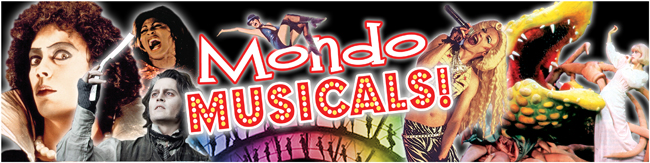
Welcome to Mondo Musicals!
Hello, and welcome to the blog! I’m so excited to finally get this off the ground. It’s Valentine’s Day 2008 and I hope you have love and romance in your life. But whether you do or not, let’s have a glass of wine and listen to some old cast albums, shall we?
About 10 years ago the phrase “Mondo Musicals” popped into my head as a way to describe the kind of shows and movies that have a special place in my heart. I’ve always loved musical theater (I include operas and musical movies in the term), but being a rather strange boy, it’s the weirdo, off-beat efforts that have a special place in my heart. Musicals that tackle unlikely subject matter, or juxtapose the subject with an unexpected musical treatment, or that push the conventions of the genre so far they seem to take place in their own surrealistic universe.
And so, we find ourselves in the strange realm of Rocky Horror, Sweeney Todd, Little Shop of Horrors, Hedwig and the Angry Inch, Jesus Christ Superstar, Chess, Avenue Q, Moulin Rouge!, and even The Wizard of Oz and the 1930s Busby Berkely films. And let’s not forget notorious flops like Carrie: The Musical and Dance of the Vampires. Musicals that push the boundaries. Musicals that redefine what a show can be and do. Musicals that make you wonder “what the hell were they thinking?” In a word, Mondo Musicals. So why “mondo”? It’s a reference to the old cult film Mondo Cane (loosely translated as A Dog’s World, 1962), an Italian travelogue showcasing shocking and bizarre practices from around the world. The success of this film inspired a vogue for “Mondo movies;” exploitation films, often gussied up as documentaries or exposés on the far reaches of human behavior. Shocking Asia and the Faces of Death series are a notorious offshoot of this fad, and Mondo Cane itself had a series of sequels. The word “Mondo” (“Earth” or “world” in Italian) came to represent anything freaky and wild, and got appended to all kinds of things, like Russ Meyers’ Mondo Topless (1966) and John Waters’ Mondo Trasho (1969). Bette Midler even had a TV special in 1982 called "Mondo Beyondo."
Here you will find my occasionally-updated musings on various shows and films that inspire, delight and befuddle me, as well as cast album reviews, MP3s, photo galleries, articles by guests columnists, and more. A few more “conventional” musicals that I enjoy will get shout-outs as well. A big aim of this website will be agitating for a “director’s cut” DVD of Little Shop of Horrors, featuring the tragic original ending that was replaced with a phony happy ending when it was released in 1986. An online petition will appear shortly.
So – welcome aboard, I hope you enjoy, and if there’s a show you’d love to talk about, let me know and we’ll get you on here. Curtain up!
Subscribe to:
Posts (Atom)