Showing posts with label frank oz. Show all posts

Tuesday, February 14, 2012

Little Shop Blu-Ray Coming Soon!

NEWS FLASH!  UNEXPECTED TOTAL ECLIPSE!
Updated June 12 - Street Date for the Blu-Ray is October 9!


So this has become The Post That Would Not Die, and I could not be happier! After a few months of murmurs, WB Home Video today started releasing materials about a Little Shop of Horrors "Director's Cut" Blu-Ray. Yea, verily, it's a red letter day for me. All my friends have heard me go on about this since 1986. I've collected a lot of related materials and memorabilia over the years, and I have dedicated quite a bit of space on this blog talking about how the new "happy ending" did such a violence to the emotional & moral core of the story. Plus, I just couldn't believe they'd cut such amazing (and expensive) sequence, a potential classic of monster mayhem which I think stands with best model FX work of all time. So glad to see the story told the way it was intended - I'm just sad Howard Ashman isn't here to see it.
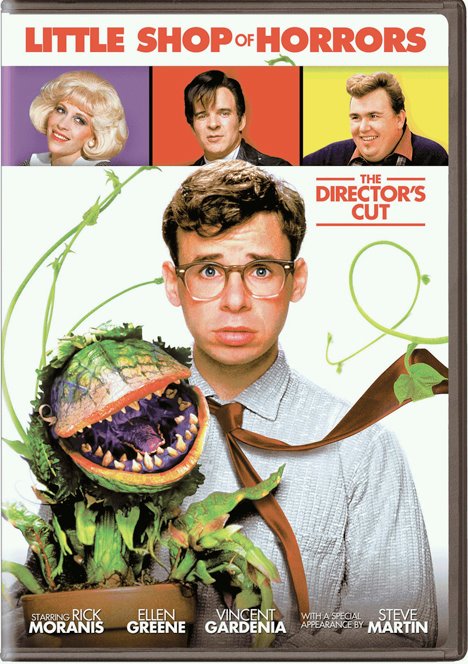
Now that my dreams are coming true at long last, allow me to nitpick and kibitz about the cover art, which continues WB's grand tradition of marketing this as just another anodyne light comedy. Inviting the PhotoShop of Horrors joke are the pasted-on "Mean Green" plant and the cartoon vines tousling Seymour's newly-added rom-com necktie (and note that one leaf is cut off at the edge). Oddly enough, they've angled Seymour's eyebrows to give him more of a sheepish, sad-trombone look. I am weirdly impressed by the particularity of that! Check out the original photo to compare. Meanwhile, the famous logo is nowhere to be seen, replaced by Futura Extra Bold. The 1960s pop art look is very contemporary and Glee-friendly, but looks a bit chintzy, and the spare design belies the film's lushly detailed visuals. At the very least, I'd have put the character boxes at the bottom. Speaking of, no Bill Murray on the cover? Nice to see John Candy get some love, but really - no Bill Murray on the cover?

Here is my previous post detailing Frank Oz's discussions about this release:

The latest issue of Entertainment Weekly has an interview with Frank Oz (illustrated with links from yours truly) in which he discusses  the decision to change the ending of Little Shop of Horrors and explains why only the black & white workprint was available for release on DVD back in 1998. Apparently the preview copy of the original ending was disassembled when the new footage was edited in, and contrary to Geffen's supposition the clips were not stored.

But more importantly, ninja spies attending Oz's Q&A at the Brooklyn Academy of Music on May 16 report that Oz confirmed that the original negatives for the sequence do exist and that there will be a Blu-Ray available for Halloween 2012! Audio recording of the interview will be made available shortly is now uploaded (thanks to Kawlen Dram!). I am overjoyed at this news, as I've been obsessed with that "lost ending" for 26 years now!  Just in time for my birthday, too. There is a also a short article in the WSJ about the BAM screening.

Oz's interview also sheds light on why the Blu-Ray will apparently be billed as "The Intended Cut" instead of "The Original Cut" or "The Director's Cut."  The true original cut was not saved, so this will be a new edit of the ending "as intended," and Frank Oz himself is not involved in the project, so it's not a true director's cut.  He also mentioned that he doesn't know if other lost clips such as the "Meek Shall Inherit" dream sequence and shots of the plant eating Steve Martin's head still survive. (UPDATE, obviously the folks over at Warner's decided that "The Director's Cut" was more marketable and changed it, presumably with Frank Oz's blessing.)

In other news, it appears that Little Shop will be remade with personnel from Glee and the very talented and very cute Joseph Gordon Levitt as Seymour. I take this news with mixed feelings, as I fear a slick, homogenized CGI-fest. Get Basil Twist on it!  But JoGoLev would definitely make a great Seymour. I could even go for Zooey as Audrey if it comes to that. However, I have to say I'd be much more interested in seeing a grisly & weird remake of the Roger Corman black comedy.  Get Rod Zombie on it!

ORIGINAL ORIGINAL POST:

Some interesting things are afoot in the world of Little Shop of Horrors.

At his career retrospective at the Museum of the Moving Image last fall, director Frank Oz said that WB Home Video is working on an original-ending Blu-Ray for the musical.  This got everybody's hopes up, but there has been no announcement or confirmation of this project - until now, it seems.  Eagle eyes (thanks, Aryeh!) have caught mention of a January MPAA bulletin giving a PG-13 rating to something called Little Shop of Horrors - The Intended Cut for late 2012!  If this is true, then it will be truly epic!  This news is so exciting I can hardly even bring myself to think about it, just in case my hopes are dashed once more. 

Just in case this is really happening and anybody from WB might be searching the net for "what the people want," (hey, I'm people!) here's my Blu-Ray wish list of what I'd love to see on the disc, including the very rarely seen storyboards by legendary comic book and concept artist, Mike Ploog.

To tide us over, the original 1960 film is being released on Blu-Ray soon from Legend.  Legend usually does good work so it should be a nice presentation of the film, which is in the public domain and thus suffers from a glut of cheapie home video releases of appalling quality.  (For my money, the best version currently available is the one packaged with Trailers From Hell Volume 2 - and you get a ton of fun vintage trailers, too!)

And here's one more taste of Little Shop goodness: a TV spot for the original LA cast, featuring the cut song "Don't Feed the Plants."

Friday, July 2, 2010

LITTLE FACEBOOK OF HORRORS

I have started a Facebook Group for people who'd love to see a new DVD of Little Shop of Horrors with the original ending intact.  Let's get Geffen and Warner Home Video to notice!  2011 is the 25th Anniversary of the film's release.  Isn't it about time?

A handy round-up of my Little Shop material can be found here, including my argument for why the original ending is integral to the film, and some very nice stills from the deleted scenes.

Here is my Blu-Ray Wish-List, which includes both new material and items from the original DVD.  While we are at it, a newly remastered version of the Original Soundtrack Recording would also be lovely.  That 25 year old CD sounds pretty tinny these days.

DVD WISHLIST

New Material:
• New HD transfer of the Original Theatrical and Restored Versions
• Commentary on Restored Version by Ellen Greene and Alan Menken
• "The Meek Shall Inherit" Dream Sequence (either reinstated, or as an extra - at Frank Oz's discretion)
• Puppetry & Visual FX feature with Lyle Conway, Bran Ferren, Richard Conway, Brian Henson, Anthony Asbury & Martin P. Robinson
• Mike Ploog's storyboards
• Photo Gallery
• Isolated score
Levi Stubbs performing "Mean Green Mother" at the Academy Awards
• Any rushes, trims, tests and behind-the-scenes footage that might still exist
• Anything relating to the original play, like this TV Commercial.
• PDF version of the screenplay by Howard Ashman
• PDF version of the FX feature from Cinefex Magazine

From the Original DVD:
• Frank Oz Commentary on Theatrical Cut
• Original Ending Rough Cut (both with & without Oz commentary)
• Blooper Reel
• TV & Cinema Trailers
• Original Electronic Press Kit documentary


SOUNDTRACK WISHLIST

The whole thing needs to be remastered.  I'd like to hear the opening verses of "Don't Feed the Plants" restored, and I'd love to include selections from Miles Goodman's excellent score as well.  And please do include any demos that might exist for cut songs, like "Crystal, Ronnette & Chiffon," "Your Day Begins Tonight," "Bad" and especially the wonderful "We'll Have Tomorrow," which was cut from the stage show.

Saturday, September 6, 2008

LITTLE SHOP - The Original Ending, Explained

Welcome, Film Experience Bloggers! I am a huge fan of Little Shop of Horrors, and I am thrilled to take part in "Musical of the Month." My post will argue that changing the film's ending to an ostensibly "happy" conclusion actually made the story far more morbid and amoral.

Before getting started on that, however, let me point you to some background on the film.

SCREEN TO STAGE - From the Corman film to the Off-Broadway show
STAGE TO SCREEN - From Off-Broadway to Hollywood
WEIRD AND EXOTIC CUTTINGS - Rare stills of the original ending, as well as storyboards that have never been published anywhere


LITTLE SHOP OF HORRORS - The Mary Poppins of the 80s?


It's well known that the ending of Little Shop of Horrors was radically altered before the film's release. In the original stage show, Audrey and Seymour are eaten, and Audrey II takes over the world. While on stage, all you see is a puppet surrounded by dry ice smoke, and the actors coming out smiling for their bows at the end, the filmed version was quite a bit more involved, and more disturbing as well.  Preview audiences found it too dark, so it was re-shot to give a happy Hollywood ending - albeit with the sequel-friendly appearance of a smirking seedling lurking in the flower beds.

This post is a look at the fatally-flawed expectations the Warner Brothers marketing department had for Little Shop of Horrors - and why their misguided notions dealt the story a crippling blow. More after the jump...

Film is an expensive art form, and studios are understandably anxious to protect their investments and reputations. And so a peculiar form of the market-branding study has arisen: the preview screening. This process is a trial run, often of an only partially-finished work, before an audience carefully chosen to meet a demographic definition of "average."

In the theatre, such traditions as out-of-town tryouts and weeks of previews are used as a crucible for discovering flaws in the production. When applied to film, this process is of shorter duration and arguably less artistic value. Rather than sampling the average response of several weeks’ audiences, most films receive only a few test-screenings. Armed with questionnaires, studio researchers try to lend an aura of scientific irrefutability to the responses of the single sample groups. When a test audience says something must change, change it almost always does.

Though this process may indeed make a film more palatable to a wider audience, it can also weaken the story, sometimes changing beyond recognition the film’s main theme. One such case occurred with Adrian Lyne’s Fatal Attraction, (1987), which originally ended with the Michael Douglas character getting his comeuppance from the spiteful Glenn Close, whose suicide framed him for murder. Test audiences rebelled and the ending was changed to destroy the Glenn Close character and reunite Michael Douglas with his forgiving family. The change was apparently successful, since the film went on to be a huge hit. However, the altered ending totally reversed the point of the film - rather than the man’s callous infidelity bringing down his whole world, his one-night-stand was punished for not accepting her lot. (The original ending is included on the DVD.)

The same thing happened to Little Shop of Horrors. The change to the ending made a fundamental difference in tone and impact, fundamentally altering the film's intent and effectively gutting its moral worldview.

WHICH AUDIENCE?

In interviews, Frank Oz noted that “the audience is a very dynamic part of a movie. You don't make a movie for yourself, you make it for the audience." But which audience? This is the paramount question of film marketing, which the test screenings are designed to answer. However, by stacking the deck in favor of a particular demographic - that which movie marketers imagine will be the most profitable - many films are not allowed to find their own audiences by their own merits.

So for which audience was Little Shop of Horrors made? A family audience, a sci-fi audience, a theatre-going audience? Certainly all of the above were represented in the crowds which had given the downbeat ending standing ovations. These same audiences have since made it one of the most popular of all musicals for community playhouses and high-school theatre troupes, right up there with Grease and A Funny Thing Happened on the Way to the Forum.

I would argue that this is the point where Little Shop of Horrors failed - not in its conception or execution, but because of the dictates of marketing. Warner Brothers intended the film for the audience least likely to appreciate its genre-bending sensibility. For Little Shop was marketed not as a Halloween treat, nor a summer special effects extravaganza, but as a family-friendly Christmas picture.

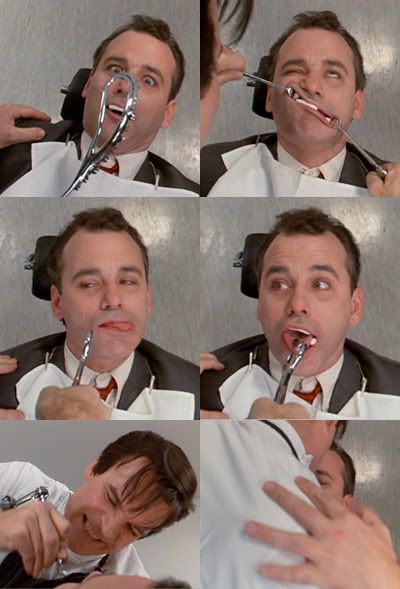
Prior to its opening, producer William Gilmore enthused, "Little Shop of Horrors will be the Mary Poppins of the 80’s and this year’s ET." Such expectations seem reasonable for a funny musical fantasy, but bizarrely misguided for a funny musical fantasy with bloodsucking, murder, and dismemberment as prominent plot points. How were mall-weary Christmas shoppers supposed to take the film’s bloodletting, Audrey’s "bruises and handcuffs," or the scene where a mincing masochist (Bill Murray, essaying Jack Nicholson’s role from the original) disgusts macho sadist Steve Martin by actually enjoying his root canal? Even without the heroes’ deaths and the doomsday ending, it sounds like a sure-fire case of right film, wrong time. Oz again: "I'm usually the one who complains when they screw up a movie by giving it a happy ending. But the movie is, first and foremost, an entertainment and it was coming out at Christmas - and as an audience member, I just didn't want to see my hero and heroine die at Christmas."

Inexplicable as the decision to release Little Shop of Horrors as a Christmas film seems, there is a precedent which may have suggested that such a strategy could work. The film in question is Joe Dante’s Gremlins, which was a big hit in 1984. Also released by Warner Brothers (with a soundtrack from Geffen records), Gremlins was an extremely dark comedy in which cuddly, mischievous pets grow into scaly green monsters whose antics quickly turn deadly. However, Gremlins was released in June, not actually at Christmas - Little Shop came out December 19. Gremlins was explicitly made and marketed as a sort of anti-Christmas movie: the film is set at Christmas, but the June release date puts it an an ironic remove from the actual holiday. Moreover, the film has a traditional happy ending: the gremlins are all destroyed, and the boy gets the girl. The death and havoc are conveniently forgotten.

Little Shop of Horrors, while morbid, is not nearly so cynical, insisting instead that its characters’ actions have repercussions. Ashman and Oz treated the characters, scenario and, ultimately, the audience with an honesty and respect that ultimately proved just too sobering.

LITTLE SHOP OF HORRORS - Amorality Tale

The two pioneering forces of modern sensibility are Jewish moral seriousness and homosexual aestheticism and irony. - Susan Sontag


The great irony is that the story's true point was completely lost with the change, and the addition of a traditional happy ending corrupted a colorful moral parable into a cynical celebration of getting away with murder. The film’s intriguing implications about race, sex, morals and money were rendered senseless, since in its final moments it negates everything stated or implied up to that point.

Howard Ashman stated that Little Shop of Horrors was to be read as "a cautionary tale, a fable which says that if you do these things, this will happen." But just as Marlowe’s Faust allowed the student to escape with his soul intact, Little Shop of Horrors as released demonstrates that murder is acceptable, even rewarded, if you’re not too bright and you’ve done it all for love. Besides, the film whispers, the two characters given to the plant weren’t very likable, so that makes it ok, doesn’t it?

In the original version, Seymour's crimes are punished with irony worthy of the best medieval morality plays or Jewish Golem tales. In the final version, however, the grisly events of the proceeding 90 minutes are rapidly forgotten. The police quickly responded to the dentist’s "disappearance" – are we to believe that they would not inquire into the whereabouts of Mushnik, or the explosion that destroyed his shop and its famous plant? Does Seymour live forever after in suburban bliss, never troubled by memories of blood and dismemberment, or of betraying the flower-shop owner who rescued him from the orphanage? In their attempt to "lighten" the tone, Warner Brothers in fact produced a nihilistic and spiritually hollow film. I would argue that it is this corrupt tone, this falsely-cheerful "happy ending," that turned audiences off far more than the dark thrill-ride of an ending would have.

Though Little Shop of Horrors did decent box-office, it was never the hit that Warner Brothers expected. Even with the "happy" ending, the film was too strange to win holiday audiences’ whole-hearted affection. The decision to change Little Shop of Horrors’ ending hamstrung a powerful and unique film. Warner Brothers, and the test audiences expecting an innocuous musical, were misled by the film's glittery surface and were therefore unprepared for the serious issues it raises. They fell prey to the misconception that important art must be humorless, and that anything which stoops to entertain is de facto devoid of intellectual content. Marketed more boldly – as a summer FX blockbuster or wicked Halloween treat - perhaps the would have tapped into something unexpected among moviegoers. At the very least, it would certainly have become an indelible cult classic. However, studios do not spend such lavish sums to produce cult classics. So while Audrey II and Steve Martin's dentist are generally remembered with affection, it is too odd to become a comedy classic, but too conventional to attract many serious cult fans. Instead of being remembered as a bold, colorful harbinger of the edgy humor of the late 80’s and 1990’s, it is remembered instead as a clever trifle – a precursor to Ashman and Menken’s Disney films The Little Mermaid, Beauty and the Beast and Aladdin.

Viewing the deleted footage today (it is available on YouTube), it is easy to see how the original ending would have been a slap in the face of Reagan's America, and a shocking left turn for family audiences expecting the same old Hollywood thing. No one wants to hear that rampant consumerism could be our downfall, or that "aw shucks" idealism could not excuse any brutality. Little Shop veers into darkness by increments, and by the time the audience realizes that the movie and the plant are playing for keeps, it's too late. That said, it is difficult to imagine how, in an era saturated with special effects extravaganzas, such an overwhelming spectacle as the plants' destruction of Manhattan could not have attracted a huge audience of teenagers, thrill-seekers, and horror movie fans.

SUBSEQUENT TO THE EVENTS...

Little Shop of Horrors was nominated for two Oscars. The song "Mean Green Mother from Outer Space," performed with gusto on the telecast by Levi Stubbs (accompanied by dancers and a 12-foot plant puppet), was beaten out by the turgid "Take My Breath Away," from Top Gun, a feel-good film in which reckless acts of war result in no serious consequences. Little Shop of Horrors’ special effects nomination was trumped by Jim Cameron’s Aliens, a great film in which blue-collar authenticity vanquishes both a treacherous yuppie and another toothy "mother from outer space." However, while Aliens certainly featured more sheer volume of special effects, the effects in Little Shop of Horrors are far more innovative and imaginative. Indeed, the respected effects journal Cinefantastique hailed Lyle Conway's work as "a new standard...another significant advancement in the field of special effects" on par with Dick Smith's makeup for The Exorcist (1974) and Rob Bottin's work on The Thing (1981). It should be remembered that most movie monsters rely on quick cuts and dim lighting to "sell" the effects, while Audrey II holds up to close scrutiny for a large portion of the film's screen time. Audrey II is not only a potent and unique creature, but a memorable character as well, brought to life with such artistry that the effects are nearly invisible. One can only wonder if the Oscar scales might have been tipped by the inclusion of Audrey II’s climactic rampage through Richard Conway's incredibly detailed miniature sets.


Despite the clash of artistic license and fiscal conservatism that made Little Shop of Horrors' initial run a misfire, we have David Geffen to thank for the chance to even make this comparison. Geffen believed in the material enough to shoot the original ending, even though his commercial instincts told him it was folly. Geffen controls the unused footage, and the 1998 Special Edition DVD was pulled from the shelves at his request. "David was upset, because the DVD used a black & white work print of the ending," Frank Oz told the Los Angeles Times. "He's a caring producer - he put his guts into the movie - and after the DVD came out, he called me and said, ‘I have the color version. This could be better.’ David either wants to re-release the movie [with the original ending] in theaters, or at least have a better DVD."

Little Shop deserves to be seen in all its gory glory, and the artists who labored over the beautifully conceived and executed original finale deserve to have their work appreciated. Let's hope a Special Edition DVD materializes soon. There is an excellent article about the recalled DVD featuring footage from the original ending at DVD Savant.

REFERENCES:

CINEFANTASTIQUE Magazine
Volume 17, Number 1 (January 1987)
Volume 17, Number 5 (September 1987)

CINEFEX Magazine
Number 30 - May 1987

FANGORIA Magazine
Number 60, January 1987

THE LITTLE SHOP OF HORRORS BOOK
by John McCarty and Mark Thomas McGhee
St Martin's Press, 1988

Wednesday, September 3, 2008

LITTLE SHOP - A New DVD At Last?

Online sources are reporting that Little Shop of Horrors may finally be getting the special edition treatment. It's about time! After the jump, a quick history of the now-legendary "deleted" special edition, and my wish-list for a new release.


The first Little Shop of Horrors DVD contained a black & white work-print copy of the original ending. This was pulled from the shelves at the request of producer David Geffen. Whereas Warner Brothers distributes the film, Geffen controls the unused footage. "David was upset, because the DVD used a black & white work print of the ending," Frank Oz told the Los Angeles Times. "He's a caring producer - he put his guts into the movie - and after the DVD came out, he called me and said, ‘I have the color version. This could be better.’ David either wants to re-release the movie [with the original ending] in theaters, or at least have a better DVD." There is a great post about this whole controversy at the DVD Savant.

Little Shop deserves to be seen in all its gory glory, and the artists who labored over the beautifully conceived and executed original finale deserve to have their work appreciated. With the film’s 2006 20th anniversary now gone, Little Shop of Horrors missed a great opportunity for revision. However, the film may yet reward another public airing. The interest seems to be there - the cancelled DVD regularly sells for upwards of $100 on EBay.com and the deleted footage can be viewed on YouTube. Movie musicals are back in vogue, with Chicago, Hairspray, High School Musical and the gloriously bloody Sweeney Todd (Little Shop was once affectionately dubbed “Sweeney Pod”). The current vogue for "director's cuts" and "special editions" has generated good box-office and critical results for such films as Star Wars, Blade Runner and The Exorcist. As paint-by-numbers digital creatures become ever more banal, modern movie-goers may be ready for Audrey II unbound. The Cloverfield monster might be larger, but it can’t carry a tune.

Let's keep our fingers crossed that this special edition DVD with all the trimmings comes to pass. In the meantime, here is my DVD wishlist. Please note that even with a "Director's Cut" on disc, the black & white rough cut must be included. It's a fascinating look at a film's middle stages - no sound effects, demo versions of the songs, and a final sequence containing much, much more footage than could ever be included in the final cut. Keep that rough cut, please!

A remastered version of the soundtrack album would also be welcome, especially if the opening verses of “Don’t Feed the Plants” were included and some of the overly 80s gloss removed.

DVD WISHLIST

• Anamorphic widescreen high-definition re-mastering
• Dolby 5.1 soundtrack

FROM THE ORIGINAL DVD:

• Original Theatrical Cut with Frank Oz commentary
• Rough cut of original ending, plus optional Oz commentary
• Trailers and TV Spots
• Promotional documentary
• Out-takes & bloopers with Oz commentary

NEW FOR THE SPECIAL EDITION:

• Director’s Cut with new commentary by Alan Menken and Ellen Greene
• “The Meek Shall Inherit” dream sequence
• Howard Ashman retrospective
• Gallery of Mike Ploog’s storyboards
• “Evolution of Audrey II” design featurette
(with input from Lyle Conway, Roger Corman and Martin P. Robinson)
• Levi Stubbs singing "Mean Green Mother" on the 1987 Oscar telecasts
• Photo gallery
• PDF or Screen Shot versions of the FX articles from Cinefantastique and Cinefex (like those included with Cronenberg’s The Fly)
• Isolated music option to showcase the songs and Miles Goodman’s score.
• Any video footage – TV commercials and the like – of the Off-Broadway musical that can be found