Showing posts with label little shop of horrors. Show all posts

Sunday, December 30, 2012

LITTLE SHOP Cuttings Sprout Online


After their disappointing non-appearance on the recent Blu-Ray, I am thrilled to see that a heap of Little Shop of Horrors cut scenes and alternate takes has appeared online, including the infamous Steve Martin head (seen only from behind), "The Meek Shall Inherit" dream sequence, and a shorter version of "Don't Feed the Plants" which is generally more effective, though still rough.

These from from a time-coded videotape, with rough FX, but all in color. Whoever uploaded them says they are copies of the version shown to preview audiences - one wonders whence they came, and why WB Home Video was either unaware of them, or unwilling to include them?

There is some great material here - some that was wisely tightened or dropped, but all of it fascinating to see.  There are alternate cuts of "Downtown" and "Some Fun Now," a longer scene of Seymour chopping up the dentist with music by Alan Menken instead of Miles Goodman, and an alternate proposal scene that reprises "Suddenly Seymour."

The "The Meek Shall Inherit" dream sequence comes off rather better than I expected, and its disappearance from the final film now really seems a shame. Its surreal imagery is definitely at odds with the studied "realism" of the rest of the film, recalling some of the Vincente Minnelli dream sequences of yore. But the song deepens Seymour's character wonderfully, and Moranis does a great job with his solo.

In contrast to the kitchen-sink approach to the finale shown on the Blu-Ray, here the finale is edited rather too tightly; I'd love to see a version between the two lengths.  Some shots, like the Statue of Liberty, are alternate takes, and others, like the disco, the movie theater, and the final screen-burst, are missing altogether. This version of the finale also features some great laughter and other vocals from Levi Stubbs, missing from the disc (which uses an anonymous voice-over artist). I love the plant that comes out of the bay going "Oooohhm!"


While we're at it, it's come to my attention that storyboard books for the film are available from collector's shops. These also really should have been on the disc, with their wonderful art by Mike Ploog, in either a gallery or as a multi-angle feature.

OK I think it's time for a Special Edition of the Special Edition! What do you say, Kurt Galvao??


Monday, October 1, 2012

LITTLE SHOP: The Director's Cut at Lincoln Center

UPDATE!  Today is the day!  The legendary long-lost original ending of Little Shop of Horrors finally sees the light of day on Blu-Ray and DVD!  And here's a great interview with Ellen Greene about the film.

ORIGINAL POST:  Wow!  After 26 years of waiting, dreaming, imagining, and hoping to see the radically different Little Shop of Horrors "original ending," and carping for years about the folks at who gave the 1986 test screenings a big thumbs-down, I was so privileged to see the movie finally get its well deserved enthusiastic reception when the original version finally screened at the New York Film Festival on Saturday, September 29.  "Heartfelt tongue-in-cheek" was how Frank Oz described the movie in his introduction, and heartfelt indeed was the appreciation for the audience, all of whom were just bubbling over with anticipation.  You can see it for yourself when the "Director's Cut" edition arrives on Blu-Ray October 9.

The Walter Reade theater is a gorgeous house, with an excellent sound system and all 268 seats filled.  Frank Oz, Alan Menken and Ellen Greene were all in attendance, and Frank Oz welcomed us warmly to the first screening in 26 years for this legendary lost ending (newly edited from the color negatives by film restorer Kurt Galvao).  Then they rolled the film (in gorgeous digital projection), and it was just like watching a play - the audience was so into it - all the jokes got laughs and each song got a round of applause, as did the characters as they appeared on-screen.  And why not? Just like a play, we knew that the creators where there to hear and appreciate our feedback!

Afterwards there was a half-hour discussion with Frank Oz, Alan Menken and Ellen Greene, plus one of the program directors from the NY Film Festival, and the film restorer, Kurt Galvao.  After the talk, Alan Menken sang a Little Shop medley, and Ellen Greene gave a heartbreaking rendition of "Somewhere That's Green."  Then we got to hear the late author Howard Ashman singing the demo for "Crystal, Ronette & Chiffon" which was meant to play over the end credits, but was dropped.

Video of the panel discussion:  Part One.  Part Two.  Part Three.

And the film itself?  First, the movie looks gorgeous. The colors are lush and rich, the shadows painterly, and the details are very fine. I noticed little speckles and details on Audrey II's skin that were never quite visible before, and little things like being able to read some of the labels on the cans in Seymour's basement, etc.  If the movie looks that great digitally projected onto a full-sized screen, it should look even better compressed into home HD dimensions.

The 5.1 remix sounds excellent, and the sound system at Walter Reade really showed it off to great advantage.  I'm glad they didn't change the very well-done soundscapes and room-tone ambiances - one of the best things about Little Shop is that the songs generally sound as if they are being sung in the environments they were shot in, and they still do.  One hopes a remastered & expanded soundtrack CD is in the works.

As for the finale ultimo...it's insane.  I can honestly see why a family audience wouldn't like it - it's very dark and grim, and heartwrenching to see such endearing characters come to such terrible ends (though again, the whole idea of selling this as a feel-good family film for Christmas was misguided).  At the panel Frank Oz reiterated his point about the characters not coming back for a curtain call, and that the "end of the world" threat is very abstract in the theater - just the puppet surrounded by dry ice - whereas on screen it's explicit and a little scary.  (Here's a thought - what if the cast credits had played over behind-the-scenes blooper footage? Wouldn't that have given a similar reassuring feeling of "it's just a movie"?)  It's going to take a couple of viewings for me to really appreciate just how radically the film feels, overall, with the new ending. But it is powerful, and I thought it was quite funny in a very black way.

The film plays Audrey's death scene beautifully, and Seymour's confrontation with Patrick Martin on the roof is very well done.  Paul Dooley is great in the role of the marketing man peddling little Audrey IIs - he gives it the perfect combination of avuncular and sinister, with a fixed grin and a gleam in his eye.  Seymour working up the nerve to jump off the building still has no music under it, which makes it play a bit flat for me, but the "chop it up" music underlines the "every household in America" dialog, and is very effective.  "Mean Green Mother" now feels very dangerous in context, and unlike in the theatrical cut, Seymour finds that bullets just bounce off Audrey's hide (but he doesn't gasp "Outer space!").

The scenes of people flocking to buy little Audrey IIs (what happened to all those props, I wonder?) look great, and the scene of the couple in bed being attacked is actually pretty creepy.  I love the news flash from Cleveland, with the frantic reporter and firefighters facing down a rampaging "Mean Green" sized plant.  The discotheque scene has really bright, vibrant colors - and white brick behind the bar.  Galvao said they had to scour film archives all over the country to find the original color negatives of the ending, and very nearly had to release the film with the discotheque sequence in B&W, until the negative turned up just a week before the deadline.

Then the film cuts to the famous scenes of New York being destroyed, and boy, do they live up to the hype.  It is incredible footage. The model work is fantastic - the Brooklyn Bridge shot got a round of applause!  The new composite shots (like the mix of miniatures and live action when the plant smashes through the movie theater) are excellent. It's also wonderful to finally see the Statue of Liberty scene finished, with night sky and helicopters circling. The colors are vibrant, and you'll be amazed at how much detail the model cityscapes have. The sequence on Blu-Ray will definitely reward frame-by-frame appreciation.

The destruction is there in full - they have cut very little from the B&W version we saw.  Personally I feel like it goes on a bit, and they'd have been better served by condensing the action down more (to, say, a 36 bar instrumental, about 45 seconds, in the middle). But it looks amazing, and at this point, they might as well put everything they have out there for us to see.  As Frank Oz noted in his interview, it's a wonderful tribute to the months of work by Richard Conway and his team that this footage is finally seeing the light of day.

Nitpicks - the baby pods don't laugh as Seymour is being eaten, which they were obviously meant to do.  The final laugh from Audrey II after he spits out Seymour's glasses is by an anonymous voice over artist - and that same laughter is heard for the rest of the film. That's disappointing - did they not have any clean tracks of Levi Stubbs laughing they could re-use? Why not just keep the awesome Frank Oz laugh from the rough cut?  Also, there is no dissolve from Seymour's glasses to the American flag - it's just a cut. The work print definitely indicates a long dissolve - that is what the black line going from left to right means.  Also, though this is being marketed as "The Director's Cut," the end credits still call it "The Intended Cut."

"The Meek Shall Inherit" dream sequence is still missing, and it was not mentioned by the panelists. Taco Wiz buttonholed Frank Oz to ask about it, but he said he didn't know if it was going to be in the deleted scenes or not. Warner Home Video film restorer Kurt Galvao was on hand, but since there was no formal Q&A, the question was not asked of him to my knowledge.  I suppose we'll find out next week, but I suspect the sequence is lost forever.

UPDATE: Having seen the Blu-Ray, I am glad to report that the two missing sound effects are present, though the "Da Doo" has less reverb than previously.  However, the dissolve from the feeding scene to Seymour's bedspread is sadly fouled up. I am also told that the DVD version of the film IS missing those two sound effects.  In the Lincoln Center screening copy of the film there were some odd errors which I really hope don't show up on the Blu-Ray.  The single "Da Doo!" heard when Seymour tells Wink Wilkinson about the total eclipse was gone, and the little wheeze Orin's gas mask makes as he dies was also MIA.  Worse for me, the long slow dissolve from Audrey II's mouth to Seymour's bedspread (after Seymour feeds him the chopped-up dentist) was instead a very fast transition and not nearly as effective. Those are all disappointing, and kept this from feeling like a "definitive" cut to me, but I can live with it if they are, indeed, on the discs.

My video of Ellen Greene singing "Somewhere That's Green" didn't record properly, so do enjoy this version by YouTube user Joshheartstheater.
Sunday, September 9, 2012

LITTLE SHOP at WALTER READE!

I just got my tickets for the world premier screening of the Little Shop of Horrors director's cut at the New York Film Festival!

Tuesday, June 12, 2012

OCTOBER 9!

That's when the Director's Cut Blu-Ray of Little Shop of Horrors will be released!
I am so excited!  See this post below for more details.  Check out my Blu-Ray Wish List here.

Tuesday, February 14, 2012

Little Shop of Horrors - The Screenplay!

On this Valentine's Day, I'd like to link to the Little Shop of Horrors screenplay by Howard Ashman, which according to the title page was completed 27 years ago today.  We certainly miss the talented Mr. Ashman but his work lives on in the beloved modern classics Little Shop of Horrors, The Little Mermaid, Beauty and the Beast and Aladdin.

Here, he makes his first foray into Hollywood screenwriting, and I hope that fans of the film will enjoy this look at the story in a stage halfway between stage and screen.  Among the notable differences are the inclusion of a short scene showing Audrey and Orin's date to the drive-in movie theater (which made its way into the comic book), and a finale that is quite different from either of the two endings that were filmed.  One might also notice that the tone of the screenplay is quite a bit darker and more melodramatic than the finished film, and wonder about the script doctoring Frank Oz did before he agreed to direct.  I look forward to hearing comments on this trove of Little Shop lore!

View the screenplay here.  Would be awesome if a PFD of this, along with Mike Ploog's storyboards, were included on the Blu-Ray, hint-hint.

Little Shop Blu-Ray Coming Soon!

NEWS FLASH!  UNEXPECTED TOTAL ECLIPSE!
Updated June 12 - Street Date for the Blu-Ray is October 9!


So this has become The Post That Would Not Die, and I could not be happier! After a few months of murmurs, WB Home Video today started releasing materials about a Little Shop of Horrors "Director's Cut" Blu-Ray. Yea, verily, it's a red letter day for me. All my friends have heard me go on about this since 1986. I've collected a lot of related materials and memorabilia over the years, and I have dedicated quite a bit of space on this blog talking about how the new "happy ending" did such a violence to the emotional & moral core of the story. Plus, I just couldn't believe they'd cut such amazing (and expensive) sequence, a potential classic of monster mayhem which I think stands with best model FX work of all time. So glad to see the story told the way it was intended - I'm just sad Howard Ashman isn't here to see it.

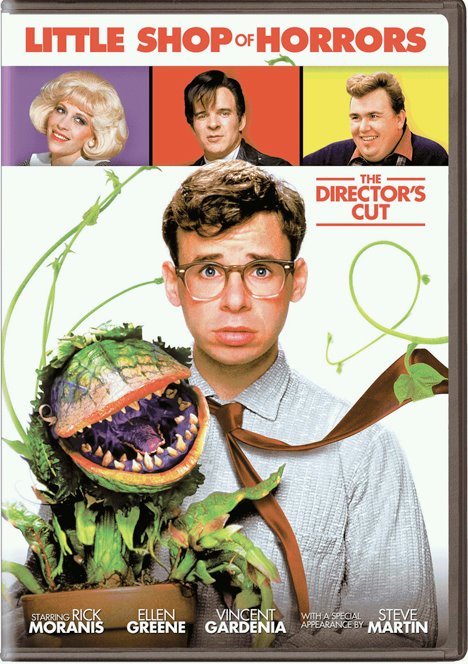
Now that my dreams are coming true at long last, allow me to nitpick and kibitz about the cover art, which continues WB's grand tradition of marketing this as just another anodyne light comedy. Inviting the PhotoShop of Horrors joke are the pasted-on "Mean Green" plant and the cartoon vines tousling Seymour's newly-added rom-com necktie (and note that one leaf is cut off at the edge). Oddly enough, they've angled Seymour's eyebrows to give him more of a sheepish, sad-trombone look. I am weirdly impressed by the particularity of that! Check out the original photo to compare. Meanwhile, the famous logo is nowhere to be seen, replaced by Futura Extra Bold. The 1960s pop art look is very contemporary and Glee-friendly, but looks a bit chintzy, and the spare design belies the film's lushly detailed visuals. At the very least, I'd have put the character boxes at the bottom. Speaking of, no Bill Murray on the cover? Nice to see John Candy get some love, but really - no Bill Murray on the cover?

Here is my previous post detailing Frank Oz's discussions about this release:

The latest issue of Entertainment Weekly has an interview with Frank Oz (illustrated with links from yours truly) in which he discusses  the decision to change the ending of Little Shop of Horrors and explains why only the black & white workprint was available for release on DVD back in 1998. Apparently the preview copy of the original ending was disassembled when the new footage was edited in, and contrary to Geffen's supposition the clips were not stored.

But more importantly, ninja spies attending Oz's Q&A at the Brooklyn Academy of Music on May 16 report that Oz confirmed that the original negatives for the sequence do exist and that there will be a Blu-Ray available for Halloween 2012! Audio recording of the interview will be made available shortly is now uploaded (thanks to Kawlen Dram!). I am overjoyed at this news, as I've been obsessed with that "lost ending" for 26 years now!  Just in time for my birthday, too. There is a also a short article in the WSJ about the BAM screening.

Oz's interview also sheds light on why the Blu-Ray will apparently be billed as "The Intended Cut" instead of "The Original Cut" or "The Director's Cut."  The true original cut was not saved, so this will be a new edit of the ending "as intended," and Frank Oz himself is not involved in the project, so it's not a true director's cut.  He also mentioned that he doesn't know if other lost clips such as the "Meek Shall Inherit" dream sequence and shots of the plant eating Steve Martin's head still survive. (UPDATE, obviously the folks over at Warner's decided that "The Director's Cut" was more marketable and changed it, presumably with Frank Oz's blessing.)

In other news, it appears that Little Shop will be remade with personnel from Glee and the very talented and very cute Joseph Gordon Levitt as Seymour. I take this news with mixed feelings, as I fear a slick, homogenized CGI-fest. Get Basil Twist on it!  But JoGoLev would definitely make a great Seymour. I could even go for Zooey as Audrey if it comes to that. However, I have to say I'd be much more interested in seeing a grisly & weird remake of the Roger Corman black comedy.  Get Rod Zombie on it!

ORIGINAL ORIGINAL POST:

Some interesting things are afoot in the world of Little Shop of Horrors.

At his career retrospective at the Museum of the Moving Image last fall, director Frank Oz said that WB Home Video is working on an original-ending Blu-Ray for the musical.  This got everybody's hopes up, but there has been no announcement or confirmation of this project - until now, it seems.  Eagle eyes (thanks, Aryeh!) have caught mention of a January MPAA bulletin giving a PG-13 rating to something called Little Shop of Horrors - The Intended Cut for late 2012!  If this is true, then it will be truly epic!  This news is so exciting I can hardly even bring myself to think about it, just in case my hopes are dashed once more. 

Just in case this is really happening and anybody from WB might be searching the net for "what the people want," (hey, I'm people!) here's my Blu-Ray wish list of what I'd love to see on the disc, including the very rarely seen storyboards by legendary comic book and concept artist, Mike Ploog.

To tide us over, the original 1960 film is being released on Blu-Ray soon from Legend.  Legend usually does good work so it should be a nice presentation of the film, which is in the public domain and thus suffers from a glut of cheapie home video releases of appalling quality.  (For my money, the best version currently available is the one packaged with Trailers From Hell Volume 2 - and you get a ton of fun vintage trailers, too!)

And here's one more taste of Little Shop goodness: a TV spot for the original LA cast, featuring the cut song "Don't Feed the Plants."

Wednesday, September 8, 2010

NSFW: Cee-Lo

Cee-Lo Green's awesomely catchy and gleefully radio-unfriendly new song apparently features the girls from Little Shop of Horrors (or their modern equivalent).

Wednesday, August 25, 2010

LITTLE SHOP OF HORRORS: Cross-Pollinization!


Since I first heard them in 1986, the Little Shop songs have been like a personal scavenger hunt for me, as I explore 60s music and find all the little references which make this an indelible bit of Baby Boomer nostalgia.


By design, the Little Shop score evokes Motown, Doo-Wop and the songs of Ellie Greenwich as produced by Phil Spector.  As a point of comparison, Menken's Brill-Building-inspired, piano-driven pop is very much in the same vein as Billy Joel's.  Of course, Menken marries these pop/rock influences to a classic Broadway sound, exemplified by Rodgers & Hammerstein (The Sound of Music, Oklahoma!, etc) and Lerner & Loewe (My Fair Lady, Camelot etc), with just a smidgen of Kurt Weill in there, too.  Menken's musical style is also quite consonant with that of Stephen Schwartz (Godspell, Pippin, Wicked).  It is surely no accident that both composers have been tapped by Disney for its newer films.


As for Howard Ashman's lyrical style and its possible influences, that is a much more difficult thing to pin down, though of course the book and lyrics abound with witty references to pop hits of the era.  One might observe that his clever, idiomatic lyrics recall the work of Frank Loesser (How to Succeed in Business Without Really Trying, Guys & Dolls, etc).


These general influences aside, I have found a lot of direct musical and lyrical quotations, and I thought it would be fun to enumerate them, with links galore for your listening pleasure.  Click "Read More" for the full list.  I advise right-clicking on links to open in a new tab, so you can listen & read without interruption.


Friday, July 2, 2010

LITTLE FACEBOOK OF HORRORS

I have started a Facebook Group for people who'd love to see a new DVD of Little Shop of Horrors with the original ending intact.  Let's get Geffen and Warner Home Video to notice!  2011 is the 25th Anniversary of the film's release.  Isn't it about time?

A handy round-up of my Little Shop material can be found here, including my argument for why the original ending is integral to the film, and some very nice stills from the deleted scenes.

Here is my Blu-Ray Wish-List, which includes both new material and items from the original DVD.  While we are at it, a newly remastered version of the Original Soundtrack Recording would also be lovely.  That 25 year old CD sounds pretty tinny these days.

DVD WISHLIST

New Material:
• New HD transfer of the Original Theatrical and Restored Versions
• Commentary on Restored Version by Ellen Greene and Alan Menken
• "The Meek Shall Inherit" Dream Sequence (either reinstated, or as an extra - at Frank Oz's discretion)
• Puppetry & Visual FX feature with Lyle Conway, Bran Ferren, Richard Conway, Brian Henson, Anthony Asbury & Martin P. Robinson
• Mike Ploog's storyboards
• Photo Gallery
• Isolated score
• Levi Stubbs performing "Mean Green Mother" at the Academy Awards
• Any rushes, trims, tests and behind-the-scenes footage that might still exist
• Anything relating to the original play, like this TV Commercial.
• PDF version of the screenplay by Howard Ashman
• PDF version of the FX feature from Cinefex Magazine

From the Original DVD:
• Frank Oz Commentary on Theatrical Cut
• Original Ending Rough Cut (both with & without Oz commentary)
• Blooper Reel
• TV & Cinema Trailers
• Original Electronic Press Kit documentary


SOUNDTRACK WISHLIST

The whole thing needs to be remastered.  I'd like to hear the opening verses of "Don't Feed the Plants" restored, and I'd love to include selections from Miles Goodman's excellent score as well.  And please do include any demos that might exist for cut songs, like "Crystal, Ronnette & Chiffon," "Your Day Begins Tonight," "Bad" and especially the wonderful "We'll Have Tomorrow," which was cut from the stage show.

Thursday, April 16, 2009

LITTLE SHOP: Another Remake?

Shock Till You Drop is reporting that director Declan O'Brien has optioned the remake rights to Corman's Little Shop of Horrors. O'Brien promises "I have a take on it you're not going to expect. I'm taking it in a different direction, let's put it that way."

My take? I think it's frustrating to consider another remake of the film while the "original ending" version of the Frank Oz movie still languishes in the vaults, some 23 years after it was consigned there by a bad preview audience.

Still, I look at it this way. O'Brien has optioned the rights to remake the original film, not the musical. There might, indeed, be some value to seeing another take on the material, a take that gets it back to its low-budget shock-comedy roots, with sick humor and buckets of gore. And who knows, it might spur Geffen and/or Warners to pony up the dough it would take to finish the musical right and put it out on BluRay. So, I am cautiously optimistic about this project.

Photobucket


-

Friday, October 17, 2008

Levi Stubbs, 1936-2008

Levi Stubbs, the gruff, soulful lead singer of Motown legends The Four Tops, has died at 72. He is beloved by me for providing the voice of Audrey II in the 1986 mondo musical Little Shop of Horrors. He'll be truly missed!

Here are The Four Tops in 1966 singing their huge hit, "Reach Out, I'll Be There." My personal favorite of their songs is "Bernadette" but I can't find a good version online. Other hits included "Baby, I Need Your Loving" and "Sugar Pie Honey Bunch."

Saturday, September 6, 2008

LITTLE SHOP - The Original Ending, Explained

Welcome, Film Experience Bloggers! I am a huge fan of Little Shop of Horrors, and I am thrilled to take part in "Musical of the Month." My post will argue that changing the film's ending to an ostensibly "happy" conclusion actually made the story far more morbid and amoral.

Before getting started on that, however, let me point you to some background on the film.

SCREEN TO STAGE - From the Corman film to the Off-Broadway show
STAGE TO SCREEN - From Off-Broadway to Hollywood
WEIRD AND EXOTIC CUTTINGS - Rare stills of the original ending, as well as storyboards that have never been published anywhere


LITTLE SHOP OF HORRORS - The Mary Poppins of the 80s?


It's well known that the ending of Little Shop of Horrors was radically altered before the film's release. In the original stage show, Audrey and Seymour are eaten, and Audrey II takes over the world. While on stage, all you see is a puppet surrounded by dry ice smoke, and the actors coming out smiling for their bows at the end, the filmed version was quite a bit more involved, and more disturbing as well.  Preview audiences found it too dark, so it was re-shot to give a happy Hollywood ending - albeit with the sequel-friendly appearance of a smirking seedling lurking in the flower beds.

This post is a look at the fatally-flawed expectations the Warner Brothers marketing department had for Little Shop of Horrors - and why their misguided notions dealt the story a crippling blow. More after the jump...

Film is an expensive art form, and studios are understandably anxious to protect their investments and reputations. And so a peculiar form of the market-branding study has arisen: the preview screening. This process is a trial run, often of an only partially-finished work, before an audience carefully chosen to meet a demographic definition of "average."

In the theatre, such traditions as out-of-town tryouts and weeks of previews are used as a crucible for discovering flaws in the production. When applied to film, this process is of shorter duration and arguably less artistic value. Rather than sampling the average response of several weeks’ audiences, most films receive only a few test-screenings. Armed with questionnaires, studio researchers try to lend an aura of scientific irrefutability to the responses of the single sample groups. When a test audience says something must change, change it almost always does.

Though this process may indeed make a film more palatable to a wider audience, it can also weaken the story, sometimes changing beyond recognition the film’s main theme. One such case occurred with Adrian Lyne’s Fatal Attraction, (1987), which originally ended with the Michael Douglas character getting his comeuppance from the spiteful Glenn Close, whose suicide framed him for murder. Test audiences rebelled and the ending was changed to destroy the Glenn Close character and reunite Michael Douglas with his forgiving family. The change was apparently successful, since the film went on to be a huge hit. However, the altered ending totally reversed the point of the film - rather than the man’s callous infidelity bringing down his whole world, his one-night-stand was punished for not accepting her lot. (The original ending is included on the DVD.)

The same thing happened to Little Shop of Horrors. The change to the ending made a fundamental difference in tone and impact, fundamentally altering the film's intent and effectively gutting its moral worldview.

WHICH AUDIENCE?

In interviews, Frank Oz noted that “the audience is a very dynamic part of a movie. You don't make a movie for yourself, you make it for the audience." But which audience? This is the paramount question of film marketing, which the test screenings are designed to answer. However, by stacking the deck in favor of a particular demographic - that which movie marketers imagine will be the most profitable - many films are not allowed to find their own audiences by their own merits.

So for which audience was Little Shop of Horrors made? A family audience, a sci-fi audience, a theatre-going audience? Certainly all of the above were represented in the crowds which had given the downbeat ending standing ovations. These same audiences have since made it one of the most popular of all musicals for community playhouses and high-school theatre troupes, right up there with Grease and A Funny Thing Happened on the Way to the Forum.

I would argue that this is the point where Little Shop of Horrors failed - not in its conception or execution, but because of the dictates of marketing. Warner Brothers intended the film for the audience least likely to appreciate its genre-bending sensibility. For Little Shop was marketed not as a Halloween treat, nor a summer special effects extravaganza, but as a family-friendly Christmas picture.

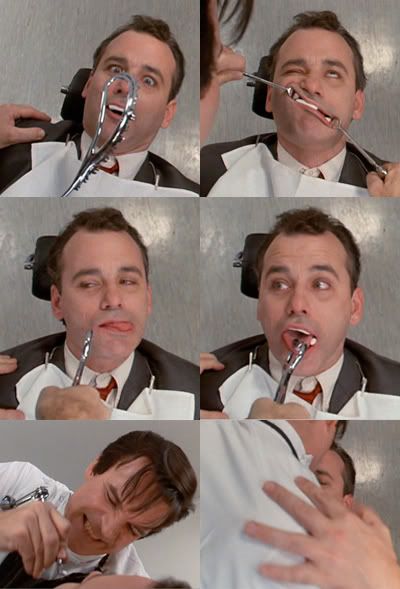
Prior to its opening, producer William Gilmore enthused, "Little Shop of Horrors will be the Mary Poppins of the 80’s and this year’s ET." Such expectations seem reasonable for a funny musical fantasy, but bizarrely misguided for a funny musical fantasy with bloodsucking, murder, and dismemberment as prominent plot points. How were mall-weary Christmas shoppers supposed to take the film’s bloodletting, Audrey’s "bruises and handcuffs," or the scene where a mincing masochist (Bill Murray, essaying Jack Nicholson’s role from the original) disgusts macho sadist Steve Martin by actually enjoying his root canal? Even without the heroes’ deaths and the doomsday ending, it sounds like a sure-fire case of right film, wrong time. Oz again: "I'm usually the one who complains when they screw up a movie by giving it a happy ending. But the movie is, first and foremost, an entertainment and it was coming out at Christmas - and as an audience member, I just didn't want to see my hero and heroine die at Christmas."

Inexplicable as the decision to release Little Shop of Horrors as a Christmas film seems, there is a precedent which may have suggested that such a strategy could work. The film in question is Joe Dante’s Gremlins, which was a big hit in 1984. Also released by Warner Brothers (with a soundtrack from Geffen records), Gremlins was an extremely dark comedy in which cuddly, mischievous pets grow into scaly green monsters whose antics quickly turn deadly. However, Gremlins was released in June, not actually at Christmas - Little Shop came out December 19. Gremlins was explicitly made and marketed as a sort of anti-Christmas movie: the film is set at Christmas, but the June release date puts it an an ironic remove from the actual holiday. Moreover, the film has a traditional happy ending: the gremlins are all destroyed, and the boy gets the girl. The death and havoc are conveniently forgotten.

Little Shop of Horrors, while morbid, is not nearly so cynical, insisting instead that its characters’ actions have repercussions. Ashman and Oz treated the characters, scenario and, ultimately, the audience with an honesty and respect that ultimately proved just too sobering.

LITTLE SHOP OF HORRORS - Amorality Tale

The two pioneering forces of modern sensibility are Jewish moral seriousness and homosexual aestheticism and irony. - Susan Sontag


The great irony is that the story's true point was completely lost with the change, and the addition of a traditional happy ending corrupted a colorful moral parable into a cynical celebration of getting away with murder. The film’s intriguing implications about race, sex, morals and money were rendered senseless, since in its final moments it negates everything stated or implied up to that point.

Howard Ashman stated that Little Shop of Horrors was to be read as "a cautionary tale, a fable which says that if you do these things, this will happen." But just as Marlowe’s Faust allowed the student to escape with his soul intact, Little Shop of Horrors as released demonstrates that murder is acceptable, even rewarded, if you’re not too bright and you’ve done it all for love. Besides, the film whispers, the two characters given to the plant weren’t very likable, so that makes it ok, doesn’t it?

In the original version, Seymour's crimes are punished with irony worthy of the best medieval morality plays or Jewish Golem tales. In the final version, however, the grisly events of the proceeding 90 minutes are rapidly forgotten. The police quickly responded to the dentist’s "disappearance" – are we to believe that they would not inquire into the whereabouts of Mushnik, or the explosion that destroyed his shop and its famous plant? Does Seymour live forever after in suburban bliss, never troubled by memories of blood and dismemberment, or of betraying the flower-shop owner who rescued him from the orphanage? In their attempt to "lighten" the tone, Warner Brothers in fact produced a nihilistic and spiritually hollow film. I would argue that it is this corrupt tone, this falsely-cheerful "happy ending," that turned audiences off far more than the dark thrill-ride of an ending would have.

Though Little Shop of Horrors did decent box-office, it was never the hit that Warner Brothers expected. Even with the "happy" ending, the film was too strange to win holiday audiences’ whole-hearted affection. The decision to change Little Shop of Horrors’ ending hamstrung a powerful and unique film. Warner Brothers, and the test audiences expecting an innocuous musical, were misled by the film's glittery surface and were therefore unprepared for the serious issues it raises. They fell prey to the misconception that important art must be humorless, and that anything which stoops to entertain is de facto devoid of intellectual content. Marketed more boldly – as a summer FX blockbuster or wicked Halloween treat - perhaps the would have tapped into something unexpected among moviegoers. At the very least, it would certainly have become an indelible cult classic. However, studios do not spend such lavish sums to produce cult classics. So while Audrey II and Steve Martin's dentist are generally remembered with affection, it is too odd to become a comedy classic, but too conventional to attract many serious cult fans. Instead of being remembered as a bold, colorful harbinger of the edgy humor of the late 80’s and 1990’s, it is remembered instead as a clever trifle – a precursor to Ashman and Menken’s Disney films The Little Mermaid, Beauty and the Beast and Aladdin.

Viewing the deleted footage today (it is available on YouTube), it is easy to see how the original ending would have been a slap in the face of Reagan's America, and a shocking left turn for family audiences expecting the same old Hollywood thing. No one wants to hear that rampant consumerism could be our downfall, or that "aw shucks" idealism could not excuse any brutality. Little Shop veers into darkness by increments, and by the time the audience realizes that the movie and the plant are playing for keeps, it's too late. That said, it is difficult to imagine how, in an era saturated with special effects extravaganzas, such an overwhelming spectacle as the plants' destruction of Manhattan could not have attracted a huge audience of teenagers, thrill-seekers, and horror movie fans.

SUBSEQUENT TO THE EVENTS...

Little Shop of Horrors was nominated for two Oscars. The song "Mean Green Mother from Outer Space," performed with gusto on the telecast by Levi Stubbs (accompanied by dancers and a 12-foot plant puppet), was beaten out by the turgid "Take My Breath Away," from Top Gun, a feel-good film in which reckless acts of war result in no serious consequences. Little Shop of Horrors’ special effects nomination was trumped by Jim Cameron’s Aliens, a great film in which blue-collar authenticity vanquishes both a treacherous yuppie and another toothy "mother from outer space." However, while Aliens certainly featured more sheer volume of special effects, the effects in Little Shop of Horrors are far more innovative and imaginative. Indeed, the respected effects journal Cinefantastique hailed Lyle Conway's work as "a new standard...another significant advancement in the field of special effects" on par with Dick Smith's makeup for The Exorcist (1974) and Rob Bottin's work on The Thing (1981). It should be remembered that most movie monsters rely on quick cuts and dim lighting to "sell" the effects, while Audrey II holds up to close scrutiny for a large portion of the film's screen time. Audrey II is not only a potent and unique creature, but a memorable character as well, brought to life with such artistry that the effects are nearly invisible. One can only wonder if the Oscar scales might have been tipped by the inclusion of Audrey II’s climactic rampage through Richard Conway's incredibly detailed miniature sets.


Despite the clash of artistic license and fiscal conservatism that made Little Shop of Horrors' initial run a misfire, we have David Geffen to thank for the chance to even make this comparison. Geffen believed in the material enough to shoot the original ending, even though his commercial instincts told him it was folly. Geffen controls the unused footage, and the 1998 Special Edition DVD was pulled from the shelves at his request. "David was upset, because the DVD used a black & white work print of the ending," Frank Oz told the Los Angeles Times. "He's a caring producer - he put his guts into the movie - and after the DVD came out, he called me and said, ‘I have the color version. This could be better.’ David either wants to re-release the movie [with the original ending] in theaters, or at least have a better DVD."

Little Shop deserves to be seen in all its gory glory, and the artists who labored over the beautifully conceived and executed original finale deserve to have their work appreciated. Let's hope a Special Edition DVD materializes soon. There is an excellent article about the recalled DVD featuring footage from the original ending at DVD Savant.

REFERENCES:

CINEFANTASTIQUE Magazine
Volume 17, Number 1 (January 1987)
Volume 17, Number 5 (September 1987)

CINEFEX Magazine
Number 30 - May 1987

FANGORIA Magazine
Number 60, January 1987

THE LITTLE SHOP OF HORRORS BOOK
by John McCarty and Mark Thomas McGhee
St Martin's Press, 1988

LITTLE SHOP - Strange Plants Are My Hobby

In 2003 I got in touch with Little Shop of Horrors puppeteer David Showler and purchased his collection of memorabilia from the film. These include his satin crew jacket, a cassette of the half-speed "Mean Green Mother" for lip-synch, some photocopied storyboards, and several pieces of the Audrey II puppets. After the jump, see my little pieces of film history!


Here's an unpainted latex skin for the "Grow For Me" pod. It's cast around a hollow resin shell, and measures about 4" long and 3" wide with some lovely sculpted veins and textures. Click on the photos for a large-sized image.


Latex leaves, 3" to 5" long, that were wrapped around the vines. There is a thin metal wire supporting the central vein (it's poking out of the one on the left.)


An unpainted foam leaf, about 13" long.


A molar from the "Mean Green Mother" puppet. It's about 6" wide and 4" tall. The clear, iridescent glitter would have made it glisten wetly in the shadowed recesses of the mouth. I think, based on the shape and the glitter placement, that this was in the left side of Audrey II's mouth (screen right).


Here's the cap from the radiator smashed during "Mean Green Mother." It's hollow resin, about 3" tall.


Here's Dave's crew jacket - it's rayon or similar "satin" material from a company called "The Cloth Tattoo" and the embroidery is hand-made. It features the Off-Broadway logo and plant.


STORYBOARDS

These "mean Green Mother" storyboards, by Marvel Comics artist Mike Ploog, have never, to my knowlege, been reproduced anywhere. One hopes that a Special Edition DVD, if it ever materializes, would include a slideshow of the full set of these. Click the images for a large-sized version.


Wednesday, September 3, 2008

LITTLE SHOP - A New DVD At Last?

Online sources are reporting that Little Shop of Horrors may finally be getting the special edition treatment. It's about time! After the jump, a quick history of the now-legendary "deleted" special edition, and my wish-list for a new release.


The first Little Shop of Horrors DVD contained a black & white work-print copy of the original ending. This was pulled from the shelves at the request of producer David Geffen. Whereas Warner Brothers distributes the film, Geffen controls the unused footage. "David was upset, because the DVD used a black & white work print of the ending," Frank Oz told the Los Angeles Times. "He's a caring producer - he put his guts into the movie - and after the DVD came out, he called me and said, ‘I have the color version. This could be better.’ David either wants to re-release the movie [with the original ending] in theaters, or at least have a better DVD." There is a great post about this whole controversy at the DVD Savant.

Little Shop deserves to be seen in all its gory glory, and the artists who labored over the beautifully conceived and executed original finale deserve to have their work appreciated. With the film’s 2006 20th anniversary now gone, Little Shop of Horrors missed a great opportunity for revision. However, the film may yet reward another public airing. The interest seems to be there - the cancelled DVD regularly sells for upwards of $100 on EBay.com and the deleted footage can be viewed on YouTube. Movie musicals are back in vogue, with Chicago, Hairspray, High School Musical and the gloriously bloody Sweeney Todd (Little Shop was once affectionately dubbed “Sweeney Pod”). The current vogue for "director's cuts" and "special editions" has generated good box-office and critical results for such films as Star Wars, Blade Runner and The Exorcist. As paint-by-numbers digital creatures become ever more banal, modern movie-goers may be ready for Audrey II unbound. The Cloverfield monster might be larger, but it can’t carry a tune.

Let's keep our fingers crossed that this special edition DVD with all the trimmings comes to pass. In the meantime, here is my DVD wishlist. Please note that even with a "Director's Cut" on disc, the black & white rough cut must be included. It's a fascinating look at a film's middle stages - no sound effects, demo versions of the songs, and a final sequence containing much, much more footage than could ever be included in the final cut. Keep that rough cut, please!

A remastered version of the soundtrack album would also be welcome, especially if the opening verses of “Don’t Feed the Plants” were included and some of the overly 80s gloss removed.

DVD WISHLIST

• Anamorphic widescreen high-definition re-mastering
• Dolby 5.1 soundtrack

FROM THE ORIGINAL DVD:

• Original Theatrical Cut with Frank Oz commentary
• Rough cut of original ending, plus optional Oz commentary
• Trailers and TV Spots
• Promotional documentary
• Out-takes & bloopers with Oz commentary

NEW FOR THE SPECIAL EDITION:

• Director’s Cut with new commentary by Alan Menken and Ellen Greene
• “The Meek Shall Inherit” dream sequence
• Howard Ashman retrospective
• Gallery of Mike Ploog’s storyboards
• “Evolution of Audrey II” design featurette
(with input from Lyle Conway, Roger Corman and Martin P. Robinson)
• Levi Stubbs singing "Mean Green Mother" on the 1987 Oscar telecasts
• Photo gallery
• PDF or Screen Shot versions of the FX articles from Cinefantastique and Cinefex (like those included with Cronenberg’s The Fly)
• Isolated music option to showcase the songs and Miles Goodman’s score.
• Any video footage – TV commercials and the like – of the Off-Broadway musical that can be found


Friday, February 22, 2008

LITTLE SHOP - Sex and the Single Vegetable

Sexually speaking, there is something rich and strange going on in Little Shop of Horrors. Aside from the relentless oral fixation of the whole piece, frustration, abusiveness, and sexual mis-matching abound: Seymour loves Audrey, but in lieu of her attention, nurtures the plant he names in her honor. Audrey chastely loves Seymour, but is trapped with the overbearingly sexual Orin Scrivello, DDS. Orin is Seymour’s evil double – the cool, successful guy Seymour wishes he could be ("Gee, I’d like a Harley machine," he muses, "toolin’ around like I was James Dean!")

Even the hilarious interlude with the masochistic patient is a parody of clashing desires: the patient’s giddy pleasure completely undermines the dentist's sadistic dominance. And isn't it odd that the Dentist, who makes his living excavating and torturing others' mouths, meets his end in the toothy maw of a creature named for his abused girlfriend?

Read more about the weird world of sex in Little Shop after the jump.

The plant serves dual roles, both as Audrey’s twisted doppelganger, and as the embodiment of Seymour’s frustrated desires and pent-up aggression - his id made vegetable. When he’d like to be romancing, he is instead tending to the wilting little bud (which goes limp after Audrey regretfully turns down dinner, because she has a date). The Audrey II design is a masterstroke of ambiguity, both phallic and vaginal at the same time (much like Giger's Alien). Its upright stalk and veiny, bulbous head contrast with its gaping, hungry trap. With no eyes to serve as a character focus, the visual emphasis is on the mouth, with its sensuous lips, jagged teeth and labial, orchid-like interior. Though given a masculine voice and persona, the relentless orality of its behavior, coupled with the feminine name, give the plant disturbing vagina dentata associations. Cementing the link with evil femininity even further, the plant is abetted by a Medusa-like nest of sinuous vines.

Towards the beginning of the film, Seymour gazes through a window as Audrey applies makeup to her black eye, and channels his dissatisfaction into the romantic / comic ballad "Grow For Me." "Oh God, how I mist you! Oh pod, how you tease!" he moans, stroking the wilted, pouty flytrap (according to designer Richard Conway, this puppet’s pouty lips were modeled on Ellen Greene’s.) When he pricks his finger on a rose’s thorn, the answer to his dilemma appears. Sucking on the bleeding finger, he hears an answering sucking noise. Looking around, he is astonished to see the plant is growing erect, its trap making little sucking, kissing motions. In short order he discovers what the plant wants – when he tries to pet it, it snaps hungrily at his bleeding finger, but haughtily refuses to even look at the other hand. Figuring "a few drops" couldn’t hurt, he milks the blood out of his finger, which the plant eagerly laps up. Thus satisfied, it swells.

Next, Seymour is seen taking the now foot-tall plant on a radio show. While Seymour isn’t looking, the plant tries to bite the ass of a female secretary in a blood-red skirt – a liberty that shy Seymour would never attempt.

Soon afterwards, the chorus girls teasingly sing that "Seymour’s having some fun now" as we are treated to a montage of him feeding the growing plant his blood. In one particularly discomforting shot, an exhausted Seymour lets the plant greedily suck his finger, with the girls’ calypso-rock beat providing an ironic counterpoint. There is an eerie sexual ambiguity of Audrey’s vampire double suckling on Seymour’s body fluids while the real Audrey has her vitality sapped by the domineering dentist. As the audience knows, but Seymour is too self-conscious to realize, Audrey wants nothing more than for Seymour to rescue her from her situation – but he is too busy with his onanistic nocturnal bleedings to notice.


When the plant reaches five feet in height, it finally speaks, launching into the bluesy, "Rock Me Henry" style "Feed Me" number, promising fame, fortune and even Audrey’s love if he’ll only track down some unworthy soul for the plant’s consumption. The plant’s come-on is unmistakably sensual – it undulates suggestively, it strokes and tickles Seymour with its vines, and promises, "A little nookie’s gonna clean up those zits – and you’ll get it!" The plant even implies that it can hypnotize Audrey into falling for him, asking, "What’ll it be? Money, girls – one particular girl? How ‘bout that Audrey? Think it over!" Seymour is still unconvinced, so the plant goes for the hard sell, exclaiming, "A lotta folks deserve to die!" Right on cue, the greasy dentist rides up on his motorcycle, backhanding poor Audrey for some minor infraction. Duly convinced, Seymour makes his way to the dentist’s office with a gun. He cannot bring himself to shoot, but the Scrivello’s addiction to laughing-gas proves conveniently fatal. Thus, the plant gets its first taste of meat, Audrey’s desire for freedom is fulfilled, and Seymour’s romantic competition is removed.

Seymour is confused when Audrey’s reaction to the Orin’s "disappearance" isn’t one of immediate joy. She feels guilty rather than relieved: "If he met with foul play or some kind of terrible accident, then it’s partly my fault, you see, because...secretly, I wished it." She painfully tells Seymour that her poor treatment was no better than she deserved. "I’ve led a terrible life," she says, conflating her sexual activity with her personal worth. She met Orin at a nightclub called "The Gutter," where she used to moonlight in leaner days.

Seymour and Audrey reveal their feelings for one another in the splendid ballad "Suddenly, Seymour." For the first time, Audrey feels valued as a person rather than a sexual object. "You don’t need no makeup," Seymour sings to her, "Don’t have to pretend." It is the most heart-felt and emotionally real moment in the film, which makes the lovers’ downfall all the more tragic. Ironically, in the original version, Audrey’s transition from sexualized bombshell to innocent "real" girl (she even puts on a white dress) spells her doom, a total reversal from the usual tropes of pulp fiction.

Walking on air, Seymour confronts rude reality when Mushnik reveals that he saw Seymour dismembering the dentist’s body. He threatens to turn Seymour in to the police, and gives him the alternative of skipping town, but leaving behind the lucrative secret of the plant’s growth (having been fed, it is now eight feet high). As the chorus girls seductively croon "It’s suppertime," Seymour backs Mushnik into the plant’s reach, and he gets swallowed.

The punishing father figure thus disposed of, there is no one left in Seymour’s life but Audrey and her double - and one of them has to go. Like a closet homosexual, Seymour agonizes over how to live a "normal" life free from his shameful secret. Showered by offers of TV tie-ins and lecture tours, Seymour plans to elope with Audrey and leave the plant to wither. Like a jealous mistress, however, the plant is not to be abandoned so easily, and lures trusting Audrey into its clutches with a masher phone call. Caressing her suggestively, the plant pleads for water, but once in reach, it wraps its python-like vines around her and drags her towards its gaping trap. "Aw, relax, doll, and it'll be easier," it leers, like a rapist cajoling his victim.

 
In the released version, of course, Audrey is only shaken by the plant’s attack and lives to stand by her man. In the original ending, however, the fusion of Audrey and Audrey II is made explicit by the heroine’s dying request to be given to the plant. "If I’m in the plant, then I’m part of the plant, so in a way, we’ll always be together," she reasons. "You’ll wash my tender leaves," she sings, "You’ll smell my sweet perfume / You’ll water me and care for me / You’ll see me bud and bloom…" Seymour’s frustrated desires – his dirty little secrets – have taken over. The substitute has destroyed the original, completing the Mephistophelean, black magic bargain struck when Seymour offered the plant his blood and the name of his true love. Instead of a wedding night carrying Audrey over the threshold of their little house in the suburbs, he carries her through the back doors of the shop and into the waiting jaws of the hungry plant.

But Seymour must still confront his anima in the climactic rock number, "Mean Green Mother from Outer Space." By this point the plant is unabashedly malevolent, and unmistakably a monster female. (After eating Audrey, the plant’s mouth turns from purple to livid red, the color of passion, of blood, of fire.) The epithet "motherfucker" is shortened to just "mother;" the plant humiliates the nerd by pulling down his trousers, and even tries to geld him: "I’m gonna bust your balls!" it rages. The plant gives birth to tiny clones of itself and swallows poor, redundant Seymour, playing out every man’s (supposedly) worst fear: re-absorption into the all-devouring trap.